Showing posts with label Africa in focus. Show all posts

Thursday, 8 July 2010

Killing time...

-->
10/06/10 

We are now in Zanzibar and have enjoyed doing very little over the last few days. It's nice to be on our own schedule now. After the tour ended we stopped in Arusha for 24 hours to regroup and find out where in our ever increasing number of bags we had packed all the little bits and pieces we thought we'd need for the trip, but actually haven't seen in at least a month. We also needed to cure our internet withdrawal. Arusha is an ugly hectic African town, although we were there on a Sunday and the streets were ghostly quiet,  apart from the tourist tat shops being open and the street vendors that collar any white person and sell the same stuff as the shops. They find the most imaginative ways to strike up a conversation and guilt you into buying something. When the tour group dropped us in the town and then headed off for Nairobi, I left Nick for 15 minutes while I found a bed for the night. By the time I got back he'd already been suckered into buying a Swahili phrasebook and was part way through buying an overpriced painting. 

We had hoped to get a room with a little luxury, mainly a bathroom you didn't have to dress to walk to.  Soon realized that bathrooms were well out of our budget and ended up at a very dingy YMCA. Our standards have dropped so much since leaving Thailand that 2 hard beds with mosquito nets, dirty draughty glass windows, a bare concrete floor and a grimy toilet 15 metres down the corridor actually felt quite luxurious. Unsurprisingly, we stayed in Arusha less time than originally planned, long enough for half a day on the internet, and to get ourselves on a flight to Zanzibar. We were meant to catch a bus, spend the night in Dar, then take the 2 hour ferry to get there. The journey on the road on the way up was so bad, and the ferry so rough that we thought the extra $70 on the flight was well worth it. Next day we arrived at the airport an hour before the flight and were told check in wasn't open. 40 minutes later and they were still waiting for 'the man' to arrive. 15 minutes before the flight he pulled up, hopped out his car, strolled over, gave us our boarding passes, and then walked us through 'customs' to our 12 seater plane. We were joined by another English couple who had been bumped to our flight when the plane they were on changed destinations at the last minute. Typical Africa.
Small planes are my idea of hell. There's too great a proportion of air verses metal around you, and being able to see out the front leaves nothing to the imagination. I was terrified making our way down the runway. We got there, started to turn, the pilots looked and fiddled with the console, turned again, and then told us we couldn't take off as there was a problem with the breaks. At least I was reassured that even in Africa they make sure everything is working before leaving the ground. It took us nearly 4 hours of sitting around before we left the ground.
Flying in an aircraft that is that light and small is not for those with a fear of flying. You feel every gust and get buffeted around like a feather. Coming in to landing I could see the runway in front swinging like a metronome. Not sure I’ve ever been more scared in a plane. Nick was happily oblivious and was taking pictures out the window. As to whether the hour and half flight is better a 12 hour bumpy bus + night in Dar + 2 hour ferry, well the jury's still out. 


Tuesday, 6 July 2010

Zebratastic

06/06/10

Today is the last day of the Africa in Focus tour. Today is the day we say goodbye to all the people we've been living in each others pockets with for 6 weeks. Some people we'll most likely never get the chance to meet up with again, but hopefully we'll see some again. Today is the day our real adventure begins, this is Africa, and we no longer have the hand holding of our crew. Now we have to organise for ourselves.

Fittingly it's been a dramatic finale to the trip. As it has been observed by all involved, this has been a trip of two halves. The first part smooth, organised and with a huge amount of activity, an adventure we'd all planned for. The second an endurance mission of a whole other kind, all be it a more 'African' one.


The view across to the rim of Ngorogoro Crater

It was originally planned for us to go to the Ngorogoro Crater for the last day and a half of the trip. As a gesture of goodwill from the company owner, to say thank you for our patience with all the problems (or perhaps to stop a hoard of complaints), he arranged for us to have an overnight stay in the Serengeti as well. Ngorogoro Crater is a huge dormant volcano that caved in thousands of years ago. It used to be the height of Kilimanjaro but is now just a rim that is 26km wide that drops 600 metres steeply to a 12 km wide crater floor. You make your way down into the crater in safari jeeps along a steep and winding dirt road. One road in, one road out. For our descent we had to go through the clouds, visibility dropped to about 5 metres at times. This was a little terrifying as Masai tribesmen would stand on the road, and donkeys and hyenas wander in the path of vehicles. Our driver was reckless and the knowledge that you are never far from an invisible plunging edge made it a pretty hair-raising ride.
We dropped through the clouds and down into the crater. Even with the poor visibility seeing the inside of the crater around you is incredible. To see it on a clear day must be amazing, but then again, like all things that rise dramatically into the sky, it's no doubt nearly always ringed with clouds. As you wind your way down the sides of the crater you can just make out herds of wildebeest and zebra. Having been on a few safaris the crater didn't really have anything new to show us, apart from our first male lion. He didn't really count though as he was sleeping far from the track and was difficult to make out. The crater was impressive for its uniqueness, a lake glinting in the sun, animals grazing all around, all isolated from the outside world by the towering walled rim. Nature at it's most dramatic.


From the crater we continued north for 2 hours into the Serengeti. It took me the first hour of the drive to recover from our ascent out of the crater. Our driver tried to kill us twice in the first 10 mins. He grounded the car on a hairpin bend, let it roll back to the edge until a number of us were screaming for mercy, then nearly tipped the car over when getting stuck in the dirt on the bend for a second time. He then drove the rest of the way with his wheels as close to the edge as possible, leaving all the space on the non precipitous side. Then he spent so much time chatting to his passenger that he once nearly drove us off the edge.
The Serengeti is everything you'd ever imagine in an African safari. In Swahili Serengeti means 'endless land'. Now is migration time and wildebeest and zebra are joining into huge herds before they follow the rains north. It was all the stuff we've seen before, but in greater numbers. At one point we drove through hundreds, if not thousands of zebras. They were scaring themselves silly and making a hell of a racket.


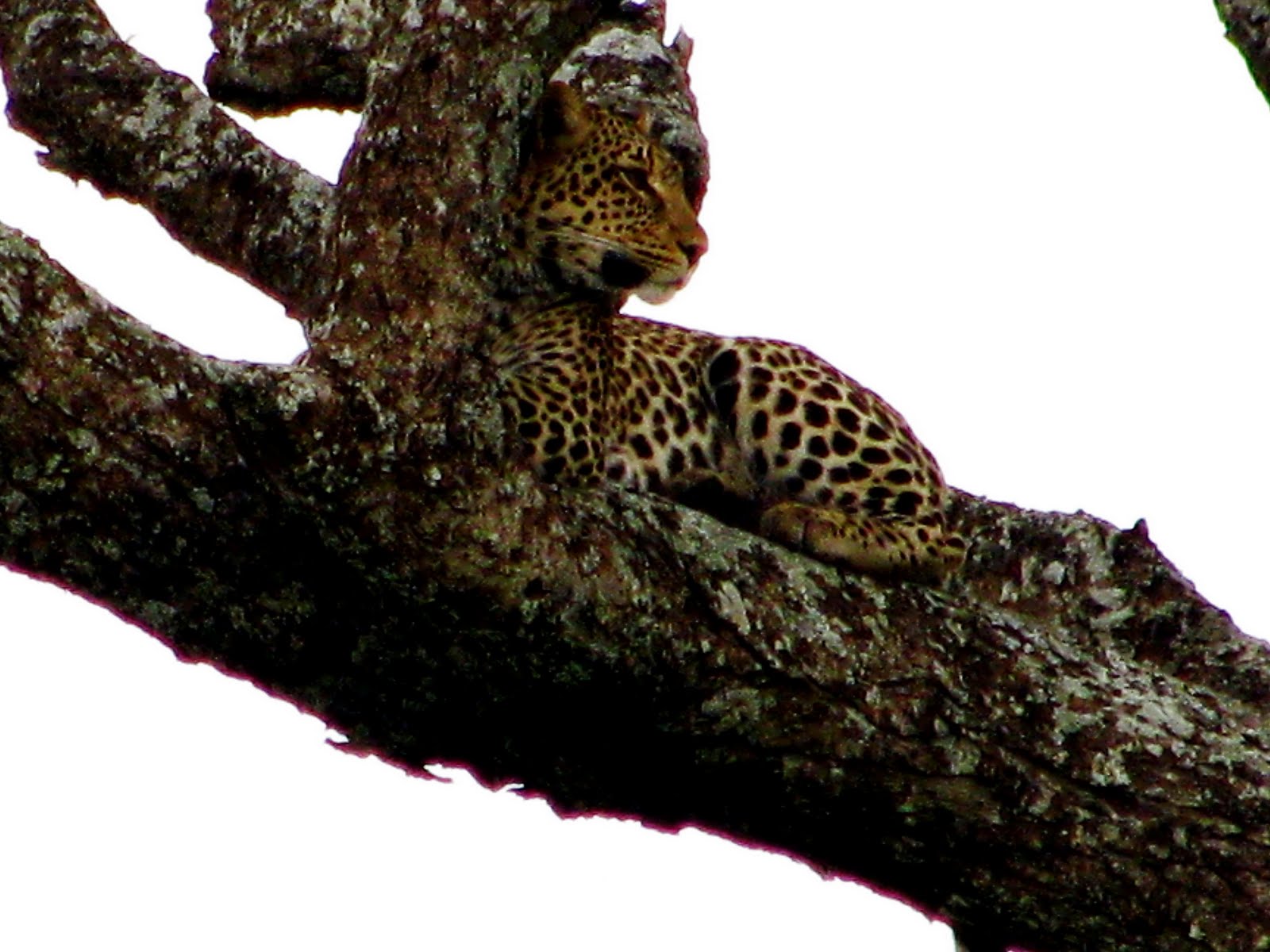
It's a miracle we saw anything at all as we drove across the plains, our driver continuing with his questionable driving sense by going 95 km an hour along a dirt road. No idea how we managed to see the more common animals, let alone some lions and a leopard. For the lions we broke the game reserve rules and drove off the road to see our first pride resting on a raised grassy knoll. When we saw the leopard we'd given up all hope of seeing one on the trip and were on our way back to camp after our last game drive. We saw about 15 safari jeeps parked all over the place. In one of the trees close to the road a leopard was sleeping off the night;s exertion with his kill hanging a few branches below where he'd dragged it.


The Serengeti bush camp was one of the most memorable places on our African tour so far. There were no barriers or fences. We were just in the middle of the open plains. In the evening a giraffe wandered over to eat a bush about 10 metres from our tent. It's only when you stand under a giraffe that you realize exactly how tall they are. At night we went to sleep to the sound of a few hundred wildebeest grunting and grazing just beyond the toilet.

Monday, 5 July 2010

Hakuna Matata...

02/06/10

One of the many varied faces of Tanzania
It has been 5 days since I’ve had time to write. The best time for doing that is when we’re sitting on the bus and we haven’t done that in a while. The mountains of Malawi and Tanzania have officially killed Benji. Even the mechanics at Mercedes in Dar Es Salam haven’t been able to fix it. After we left on the Romping Rocket minibus they managed to fix ii briefly before it broke down on a main road running right through the centre of a game park. With the help of lots of friendly villagers they got themselves to Dar and into the Mercedes workshop. Apparently it’s common for vehicles to go into African workshops and come out having had all the good parts discreetly stolen and replaced with older ones. At Mercedes every time either John or Ebron went into the workshop they got patted down on the way out. We had to stop off there and collect our tents and say an early goodbye to two thirds of our crew. They have to stay with the truck while Gareth carries on with us. It is up to them to get the truck ready for its longer and more challenging return journey.

Tanzania is an incredible place. It really is the Africa I’ve always imagined. With Mt Kilimajaro and the Serngetti planes, it has dramatic and majestic mountains that skirt the edges of flat and fertile grasslands. This is Lion King country. The people here seem more proud and confident than others when faced with a bus full of mazungus (white people). Brightly dressed women in head scarves carry heavy loads on their heads, Masai tribesmen with varieties of rich red cloth draped around them sit and laugh on their mobile phones with trainers on, holding their spears at their sides. The women here are beautiful. Tall, graceful and elegent. As well as the bright wraps many of them wear long black dresses and full headdresses. These plain outfits are surprisingly flattering, with only dark kohl rimmed eyes to be seen.

Some of the amazing beach scenes on Zanzibar
 
As well as ‘Lion King Country’, Tanzania has huge variety in landscape. We have just driven through an area that was pure ‘Hawaii’. Sharp mountains covered in lush vegetation plunging to a palm tree forest floor. Then there is Zanzibar, the feather in the cap, adding floury powder white beaches and turquoise crystal wasters to Tanzania’s tourist pulling repertoire. Zanzibar has the best of many worlds. It has the beauty of the Caribbean, the style of Morocco, and the laid back attitude of Africa. The locals greet all with ‘Jambo’ and give up on sales pitch hastles with relative ease, leaving you with ‘hakuna matata’. It is a stunning stunning place and I can’t wait to go back for a week of chill at the end of the tour.


The only bad thing about Zanzibar was the return ferry trip to the mainland. Got so seasick that my arms cramped up, my jaw started to lock and my hands went green. Glad to be away from the boat and back on a bus, even if it’s 5.30 pm and we’ve still got 300km to go.

Sunday, 4 July 2010

Death of Benji...

28/05/10

The next day... We have travelled 35 km in 5 hours. We have stopped and started again 5 times. It is 3.30 and we have 350 km to go today. An integral part of the engine has just been sent off in a public minibus full of strangers to be fixed and returned on a later bus. Our guide and chef hiked off up the road hours ago to hitch into the next town and find us alternative transport. Not only do we need to get 350 km to our next camp, but we also need to make it the 600 km to Dar Es Salam tomorrow. We have packed our bags and are leaving John and the truck. We have spent the last nine days breaking down, sitting around at the roadside, leaving in the dark, arriving in the dark, and basically trying to keep calm in the frustration of the journey. The aim of the trip has changed. We are no longer trying to spot wildlife and experience African culture, we are simply trying to carry a broken truck across a very large continent.
….
It’s 10.30. Another long, long day. Just arrived in camp. Not the camp we were supposed to sleep at mind. It’s not the camp where we had a meal prepared and waiting for us. That camp is some 70 km back in the other direction and we passed it about 2 hours ago, where hopefully the staff have now had a nice bonus meal that they had ready prepared for us no shows. How nice it would have been to stop at 8.30, eat and get an early night. Instead we have to arrive at an unknown camp, wake the owners, and pray they have rooms or set tents. We are now ‘travelling light’ and have left our tents on the bus.
We left our Benji the truck at 4.30, having managed 30 km of our 390 km day. Gareth commandeered a big minibus to take us and all our stuff the next 900 km to Dar Es Salam. Dan quickly named our new minibus the ‘romping rocket’. It is manned by to locals who drive it at breakneck speed with African music blaring out and drowning any possible conversation. With another great African sunset behind us and the most incredibly vast full moon rising in a lilac sky to the right of us, it feels like we’re really doing it African style. To be fair though, our bus is built for 26 people, and there are only 12 of us on it. To do it African style we’d need at least 60 more people on here. Earlier Gareth and Ebron the chef stopped a minibus on it’s way into town. Much to their disbelieve they were herded onto a 12 seater bus that held 30 people for the 20km ride into the next town. As Busman told us all those weeks ago in Namibia “In Africa a vehicle is never full”.
Today has been the most testing day of the journey. Sitting at a roadside for over 6 hours, being subjected to ‘Heal the World’ and ‘Words’ blasting out on a loop for 6 hours (bad dated western music soon replaced the African music), getting lost in the dark and wasting 2 more hours, and having to say goodbye indefinitely to two of our three crew. I never considered for a moment that I would be the first to flip out on the trip, but today I came really close. Frustrations are running so high that even Dan, our most optimistic traveler became despondent. 600 km day tomorrow.

There has been no photo taking on this part of the trip.

Saturday, 3 July 2010

The rot sets in...

27/05/10

It started out as any other normal day… as normal as it gets out here. Already tired and grouchy due to the night with ants, I wasn’t amused when our “fixed” truck broke down after 30 minutes. We stopped for an hour, having lost power and rolled downhill and stopped partly in a ditch, then set off revving hard. Soon after this we reached a queue of trucks snaking up the hill. We powered past them as fast as our dying truck could manage…a right ripping speed of about 20 km an hour, and onwards towards a huge lorry that was stuck in the middle of the road and blocking our view. The road was in really bad condition and full of clay. With the heavy rains that morning the road had become a wheel spinning quagmire of a car trap. We made it level with the other truck before we ground to a halt and started to slide back into it. There must have been around a hundred locals standing around and clambering up around the sides of the mud. With remarkable speed and efficiency a group of local guys gathered and produced a rope. They attached this to the front of the truck while we all clambered off into the mud. At this point I still didn’t really believe I was going to see what I was going to see.
Watching twenty men and all the guys off our truck pull/push the 45 ton truck uphill through the slippery mud really had to be seen to believed. I struggled to watch as Nick had decided to position himself right next to the sideways slipping, mud slinging back wheel, with only his flipflops for traction. Many people were barefoot. How someone didn’t lose their footing and end up under the truck I don’t know.
Incredibly they made it the 50m to the top where we gave the helpers the spare cash we had available (about $80) and they erupted into huge cheers. We then gave a lift to a local guy whose car was stuck, into the next town where he was going for a job interview. It was only then that we found out from him that the very same men who helped us get up the hill, had been out the night before damaging the road to make it impossible for vehicles to pass unaided. Doing this whenever it rains is how they make their living. Annoying, but enterprising. I was still grateful nonetheless. A tour group had had to camp there the week before, waiting for the ground to dry out.
Our journey continued up into the mountains. With the breakdowns, mud challenge, and slow hill climbing pace, it was decided that we wouldn’t stop for lunch and would grab snacks on route. We crossed the border into Tanzania with the truck making new noises of distress every kilometer. It was late and we had 70 km to go. We made it 10 km further before the pipe to the compressor snapped and we lost all brake pressure. John, Gordon and Dan stayed out in the rain for an hour trying to fix the pipe with duct tape, cable ties and wire. Having a steep winding decent on dark wet roads ahead of us nobody was really to keen to test this repair job. We made it 10m before it blew. The rain was torrential, there was nowhere to set up camp and we prepared sandwiches in our seats for dinner. Work continued on the bus and at 10.30 we were told it was fixed enough to get us to the next town. There was then a long discussion between all on board as to the merits of talking the hill with the fix verses the sleeping on the bus where we were. Surely it’d be easier to deal with in daylight hopefully without rain. We were eventually convinced that it was ‘reasonably’ safedue to the accumulating pressure tank (in non mechanical speak this means…not quite instant death when the pipe bursts going down a hill). The whole idea terrified me, but I actually slept the whole journey and woke when we bounced into the hotel carpark at midnight, the pipe having burst 30 metres up the road. Our expensive hotel upgrade cost us $30 and not having to put the tent up and down in the rain was worth every penny.

Sunday, 20 June 2010

WheretheMalawiarewe...?

-->
23/5/10

After yet another long day driving we arrived in the capital city of Malawi late last night. As with every time we end up driving round in the dark things went wrong. A truck of that size is not easy to manoeuvre, and getting lost and the resulting 3 point turns are no fun. We arrived too tired to deal with our own tents and gratefully accepted the offer of an upgrade to ready made cozy bedded tents for the pricely sum of $1.

Up again at 5.30 today. These early dark mornings are loosing their novelty. 30 minutes into the journey and we're climbing up slight hills at 15km an hour, before pulling over and trying to solve the never ending power problem. We waste thirty minutes at the side of the road and set off no faster. The truck is definitely on it's last legs. People are starting to get irritated. We leave an hour before any other truck and arrive hours after them. Activities and exploration time is cut short due to never ending drives. We are experiencing Africa only through a truck window. Getting up at 5.30 so we can make 400 km in a day is silly. There is now talk of hiring minibuses. It is really hard for Gareth and John, our guide and driver, it's their first trip with this company and they are having to deal with a dying bus.

Malawi, country number 5 on our tour. It has been called Africa for beginners, with it's wide range of activities, beautiful scenery and apparently the most helpful and friendly people on the whole continent. Not sure the first Western explorers to arrive here would have agreed, missionaries who came here to do their stuff. Hundreds died for every Malawian that they managed to convert to Christianity. Malaria is pretty rife here.


Malawi is a relatively small country, 900km long and between 70 and 150 km wide. A lot of this area is taken up by Lake Nyassa which separates the country from Mozambique. With a population of about 14 million in such a small area, it has one of the highest population densities in Africa. The towns we have been through have had vibrantly hectic streets; people milling everywhere, markets bustling and music and singing. As with Zambia, kids appear every time we stop to watch us, and can be seen sitting in the dirt barefooted and in rags. They shout 'Mazungu', meaning white person when we pass. You can't help but be affected by this sight when you see it so often. It hurts me that they have so little and we have nothing to really give them that would make a difference. In the past we have been told not to give kids pencils are pens as gang leaders often make kids go out and practice begging then take whatever they get. We've been told that doesn't happen here and that they are just grateful for anything that they can take to school. With an average GDP of $170 school equipment doesn't come high up on the list of priorities.


Contrary to all appearances, John says that as far as African countries go, Malawi is now doing ok. In 2005 there were drouts and famines that crippled the country but it has recovered for now. Life expectancy is about 40.
One interesting fact I've learnt about Malawi...the first president here, President Banda who had control of Malawi from 1966-1994, had some rather curious habits. As with many African presidents he leaned towards the dictatorship style of leadership, but his eccentric behaviour went as far as wearing ganster clothes and hats, waving a flywhip around and having dancing girls follow him around whenever in public, all dressed in clothes made from cloth with his face printed on it. They were there to chant praises at him.

Sunday, 6 June 2010

The longest day...

22/5/10
Just got back from South Luangwa. Got back isn't really the right term really, as we never left the bus and we're on our way to somewhere completely different, but we are back to some kind of civilization, and more importantly back to tarmac.
Our journey to South Luangwa started slowly. As I have mentioned before, the roads in Zambia are crap, even those lucky enough to be covered with tarmac. We started at 7.00 and had only done 150 km by lunch and then broke down soon after. Repairs took a long time and we still had 130 km off 'really bad' dirt roads to go. At first bouncing and bumping along the red dirt roads that were under construction was almost amusing, everything got rattled off shelves and across the floor. You drive past small thatch huts that kids run out waving and shouting from, makes you feel famous. The people here have really dark skin and when they smile it literally lights up their face. The kids we pass are all happy with nothing more than a wave and you are rewarded with this huge great grin. This along with yet another amazing African sunset and we were almost distracted from the bumping for a while. With the onset of darkness however, there came a lack of waves and smiles and the journey began to get irritating. Three hours later and even the most mild mannered on the bus were becoming highly strung. Huge potholes that whip lashed us from side to side and constant rattling that shake the bones and gets inside your head.. no stopping, no breaks, 6 hours in all on that dirt road. It was like Chinese Torture. To make matters worse we were driving in the dark, and in remote places things always go wrong when it's dark. When we eventually reached the entrance lane to where we were staying, confusing signs and us not really being able to see much after having our brains shook loose for a day resulted in us going the wrong way. After wasting another hour battling through gulleys and a track built for narrow 4 wheel drive vehicles, 3 wrong turns, 2 fallen tree blocked routes, an incident requiring sand tracks, and we were lost in the middle of a forest in a game park. Our guide Gareth was not amused when we insisted enough was enough and we really now needed a toilet stop. It took us 7 hours to go 130 km. 


The reason we went through this huge ordeal was to visit a game park with a big reputation. Not only is it reportedly one of the best places in the world to spot the elusive leopard, but is also one of the least visited parks you can find. Wonder why that would be then...

One game drive can be much like any other, and I'm not going to bore with too many more details. That is apart from to say that South Luangwa is the Jurassic Park of game parks. It is not the flat open planes from the TV, but it is huge and it is beautiful. With a river, small planes, forests, ponds, lagoons and coursed with winding waterways, it's the perfect image of a game park. We didn't see anything new there, no leopards or lions, but the concentration of animals was incredible. It was the game viewing I've always imagined, giraffes blocking the road, piles of hippos snoozing in green stuff, baby elephants next to the car. We even had hippos nudging tents at the stunning riverside Wildlife Camp. The only bad thing about being there was the fact that we were 6 hours away from the nearest tarmac and had to go back the way we came. 


As you travel through Zambia you are constantly reminded of how poor the country is. Dan was followed a kilometre back to camp by a kid who had asked for a pen and was willing to do a 2 km round trip just for a pen. At our most recent grocery stop lots of left over stale bread was given to the guys hanging around our bus. It's quite humbling to see men get so excited over slightly mouldy bread. You quickly realize how privileged we are. Apples with a few bruises that get looked at and then put back by everyone on our bus are seen as a real treat by kids with no shoes. Life expectency here is 33. 


Zambia... the beginning of the decline of Benji.

-->
20/5/10

Zambia…seem to have developed narcolepsy since we have left Livingston. Struggle to stay awake for more than twenty minutes at a time on the bus. Not sure how it is possible to sleep so much, in the words of the Lonely Planet ‘Zambia’s roads are crap’. We have just suffered a breakdown. Our truck 'Benji' is starting to crack under the pressure. With the amount of shaking and rattling we’ve done today it could be any number of things that have shaken loose.

With all the sleeping it’s been hard to see the country. Bit annoying really as it is quite a different landscape to what we have been trough so far. The rolling hills are thick with trees and the roads winding up through them remind me more of Central America or Indonesia. From the few lucid moments I’ve managed, the other difference that’s quickly apparent is the increased population. Zambia has about 11 million people, a great deal more than the last two empty countries we’ve been through. There are small thatched rondhavel compounds everywhere. Kids, cows and coats wander along the side of the road. It’s hard to find a private bush stop toilet, within minutes some curious sole has popped out through the bushes, wandered over to take a look or ground to a halt on a bicycle by the side of the road. Over 50% of Zambians are subsistence farmers, people spread out all over the place living off the land and leading a very basic life. Zambia has had its share of problems, and in recent years has been one of the poorest countries in the world. People earn about $60 a month. Driving through the small towns you can see religion and experiences reflected in shop names. The “Good Struggle Grocery”, “Faith is my food” restaurant, “Jesus is my way” grocery, and my personal favourite; “The Hangover Clinic”.

We have been driving for 3 days to get to South Luangwa Game Park. We have been told that the drive is well worth it when you get there. Whoever said that hasn’t been along this road recently. Due to its remote location it is one of the least visited game parks in the world. It has been a long drive. 1200 km in all. In the trip itinerary we were supposed to make the journey in two days, but as we had not others joining for the next leg we left a day early. Broke the marathon journey up and had the bonus of a campsite with zebra wandering through it.

Thursday, 27 May 2010

Overnight on an island

12/05/10
.
Guma Lagoon is a tranquil resort that sits on the edge of a permanent lake in the delta. With swimming pool, horse riding, and a huge wooden dining deck to the water’s edge, it was one of the posher places we’ve camped. We even got to eat at a table for a change. We stayed there for one night before being taken in tub like speed boats 10km further into the delta where we would meet the mokoros. Mokoros are traditional canoes made from hollowed out tree trunks. These are then ‘driven’ by a skilled poler who stands at the back and punts with an 8 ft pole. 

 
 We were taken, kitchen and all, in the mokoros three hours deeper into the delta. We went through narrow channels cut into the tall elegant papyrus grass, lily pad gardens and spiky plants that covered us in bugs. It’s a really peaceful and relaxing way to travel, but at the back of your mind you’re always aware that you’re surrounded by hippos, elephants and crocs in a boat that sits only 10 centimetres out of the water. On the way to the camp we stopped at an island with elephants. We were warned not to talk, to tread lightly, and to stay in a close group behind the guide. The guide and mokoro men were clearly very nervous. It was a little daunting standing 30 metres away from such large animals. You have no chance of making it into and away on wobbly mokoros if they charge.


Arriving at the chosen island to camp on we found it was actually an elephant’s toilet. The size of the deposits means it doesn’t take many elephants to make a whole heap of mess, literally. This didn’t seem to bother those in charge and we tried to set up tents between the mounds. Nick then spotted 3 bull elephants about 20m away from us in the bush. Having watched the mokoro men around the elephants earlier we expected to be told that we’d need to move islands, but we were just told not to wander. With camp set up and lunch finished we found that unlike usual we had some time to kill. The long driving days take their toll and we all were happy with the chance to rest. It soon became clear that nobody was going to get to snooze due to the extreme racket coming from the Botswanan or ‘Swanan’ side of the camp. It is considered rude in Botswana to speak quietly when in a group as it means that you are speaking badly of someone. As a result we had 15 men sitting in a circle shouting at each other. This detracted somewhat from the relaxation qualities of being out in the bush and away from civilization. To make it worse, they all seemed to have so much to say to each other, they hadn’t stopped talking all day.

Going out in the mokoros for sunset was about the only time that the men stopped talking. Instead they looked around nervously and were reduced to hissing, clicking, whistling and pointing fearfully into bushes. They seemed scared of their own shadows and constantly looked over their shoulders. Their fear convinced us of death by hippo at any minute. We kept hearing them grunt but we never saw them. There were quite a few elephants feeding and wading between islands, and one bull elephant mock charged us when we startled him. A mock charge involves head shaking, ear flapping, and a bit of noise. This doesn’t sound that scary, but when you’re confined to a tiny hand powered wooden boat it’s reasonably terrifying. All the elephants were good to see, but it would have been nice to catch a glimpse of a hippo or croc, after all in the nature programs the delta’s full of them, our expectations had been high. Later that night there was a hippo heard grunting behind the tents, but that really wasn’t the encounter any of us were wanting.

Left Guma this morning and made it back to the truck to find it had been fixed. So fixed in fact that John had managed to get a speeding ticket. We now rattle along at a far more respectable 75 km an hour. That was of course after we eventually managed to get going having freed ourselves from yet again getting stuck in the sand.

Also… seem to have survived the brush with the dodgy hot dog.

Wednesday, 26 May 2010

Sticky days

-->
11/05/10

Have been away from the bus for 3 days on the Okavango Delta in northern Botswana. Nice to have time away but was grateful to return to comfy seats. Also relief to be back to tarmac roads, until the next sand patch that is. We have had days of getting stuck. First we got stuck driving into the campsite after a 14 hour day. Got a tree between the wheels that our driver John had to saw out. John looks a little like Clint Eastwood and has a slow, strong accented way of speaking. His knowledge about people, places, history and geology so far have been amazing. He has seen everything so many times but doesn’t seem to get bored with it. He is completely unfazed by anything. Even after a tough 14 hour day, and then having to hack a tree out from under the bus, he calmly climbed on the bus and proceeded to tell us all about the scenery we missed while driving in the dark. He is never too stressed or busy to give us advice and he never stops fixing the bus. In fact, as I type, he is under the stationary bus now, trying to wedge the compressor, that has sheared off its bolts, back onto the engine with a stick. Apparently this is our best hope to get us the 100 km to our next destination. John is never happier than getting some quiet time and finding some space to go off alone with his binoculars and bird book.

The following morning in our trials of getting stuck, we packed up to leave camp early so we could get a head start and proceeded to get stuck when trying to turn the bus around in sand. Would have been relatively simple to solve if the sand tracks hadn’t got caught on the underside of the truck and bent like a sheet of aluminium when the bus drove over them. We got out the sand, demolishing the rock border of the path on the way, but then had to spend a long time getting the heavy tracks flat enough to attach back on the bus. We then drove all day, bus seeming to get slower and slower, motoring at 55km per hour, into Botswana and down the side of the Okavango Delta. We stopped in a small village and transferred luggage, tents, kitchen and food for three days from our truck to an even more tank like one. The 45 minute drive on to Guma Lagoon Resort needed to be done in 4x4, but one that has wheels 4 ft tall. We left John with our bus with the aim of getting the engine fixed, while we rattled and bumped off, gears grinding and with diesel fumes pumping into the open sided truck.


As we followed the sand track through the village it quickly became clear why we need a 4x4, and one so big. We were to spend most of the 45 minute journey driving through water. Our confidence in the vehicle was shaky from the off, and when we entered the first big stretch of water we ground to a halt and the back left wheel sunk 3 ft into the sticky mud. It took them a surprisingly quick 20 minutes to free it (the slightly inadvisable African technique of winching it up on a jack and then driving off the jack), before we waded out and got back on it. We set of with great trepidation. Not quite sure how, as the water sometimes made it 4 ft up the truck, but we made it to the resort without further incident.


Tuesday, 25 May 2010

Angry elephants and chilled rhinos

07/05/10

This morning we left Etosha and are now driving to our last camp stop in Namibia, 500 km on in the Caprivi Strip. We then have another long drive after that to take us to the Okavango Delta.
Yesterday’s drive within the park between the camps was not as exciting as promised. We had been told to expect lots of cools stuff later in the day as we got further in the park. Instead it actually felt like we were leaving the animals behind, that is apart from springbok which are even more prevalent than zebra, yet certain members of our group still insist on shouting stop for, and must have near on 500 photos of them. There were a few birds on the drive, but it’s hard to get excited about a bird when you’re expecting a rhino. Out of desperation I think, our driver suggested we go back out after setting up camp to recheck the local waterholes. We were all really hot, tired and burnt, and most would like nothing more to start drinking by the pool, but I think we all felt that if we didn’t go something good would be spotted. It’s like those dive trips, you really can’t be bothered to get back in the water for a fourth time that day, but you know if you don’t a hammerhead will show up.


We drove around the waterholes and they were all empty. This is the end of the rainy season and the seasonal lakes and rivers have filled, so animals normally dependant on the waterholes can go elsewhere. Our last stop was a beautiful natural pond. We arrived and found about 11 giraffes milling around. One posed nicely for a reflection shot in the water, while two others even started to mate. Our driver told us later that they were actually 2 boys. Didn’t know giraffes were amongst the mammals that were that way inclined. You learn something new every day. There were also lots of springbok, impala, and elands. Elands are the largest antelope, and are more like cattle than all their other more graceful relatives. While we were distracted with them a bull elephant snuck up on us from behind. He was quite small and was obviously suffering an adolescent day, flapping his ears, shaking his head and stamping his feet. He stomped directly for us before conceding to our bigger mass and veering away, all the while eyeballing us. He then went to take out his anger on everything else smaller and skirted the waterhole stomping towards all the other animals until they ran away. He left without even having a drink, and continued to stomp off towards the forest, backside showing, tail flicking angrily. If he had had a door, he would have slammed it.
While all this was happening, a very calm and confident black rhino sauntered (as much as something built like a tank can saunter) over towards the water and then calmly posed, very obligingly on the opposite bank to drink water. The shots of him and his mirror like reflection in the water had all the cameras going. We stayed at the waterhole with the sun going down behind us until we realized the time and had to rattle, bang and hiss off as fast as we could to get back before we got locked out. A dull day turned into one of the best days we’ve had.


……
Now nearing the end of the longest day on the bus so far, have been travelling for just over 12 hours with 2 more to go. Perhaps the tired brain accounts for the potentially huge error in judgment just made. Stopped at a dingy petrol station and maybe it was the news of another 2 hours driving that prompted us to buy a soggy looking, cling-film wrapped hot dog. Ate it, enjoyed it, then heart sank at realization of potential and highly likely food poisoning to come…

Monday, 24 May 2010

Game parking...

-->
06/05/10
.
Driving through our first game park where we have been based for at the last 2 nights. We have been staying at a campsite 18 km in and have done morning and afternoon drives from there. Now driving through the park to a different campsite 75km further in. We seem to have left all the animals behind. No more herds of springbok or zebra.
When we first entered the park gates, within minutes we had seen zebra, wildebeest, warthogs, springbok and oryx. This all supported my idea that once in the park we’d have hoards of animals wandering around us and obligingly posing for shots that’d instantly male me look like a pro wildlife photographer. Everyone’s seen the pictures of cheetahs climbing onto the bonnets of cars, and elephants walking right up to vehicles. Entering the park through the big gates and fence actually felt disappointingly like we were entering nothing more than a big zoo. I had had it in my head that being in a game park would give me a chance to see the Africa of old, that which is undamaged and unchanged by peoples poaching and encroaching habitation, but the fences took an element of wildness away.

On the first game drive it quickly became apparent that Etosha is no zoo, and there would be no animals posing patiently by the side of the truck. Etosha is about 200 km wide. Seeing animals is a lot more hit and miss than I thought. Apart from zebra, which appear to be everywhere, you have to search hard for animals, and you also have to be lucky. On the first day everything seemed to be on the horizon, or at least a lot further than my eyes are able for. Also a lot further than our 250mm zoom lens was able to capture. Definitely no wildlife photographer of the year award for me. Thankfully the posh campsite we were staying in had its own waterhole. You got to kick back and relax with a bottle of wine while watching bull elephants, zebra, giraffes, jackals and even 6 black rhinos. We slept in the tents with the territorial calls of lions about 100m away. Going to the toilet in the middle of the night was a test of character.

The second day’s drive was far more successful, with us catching more things closer to the road. We even got to watch a lioness stalk and chase a herd of zebra. The height of our truck gives us a great advantage over other cars and game trucks. We can see further and spot things easier amongst the long grass. It does however rattle, bang and hiss with open roof hatches and hydraulics as we go over rough roads. It kind of puts an end to any sneaking up on animals.


Being on a game drive is surprisingly tiring. Sitting trying to be patient and squinting into the sun for hours, trying to see stuff that’s got the distinct advantage of years of evolutionary practice to perfect the art of camouflage, can be tense and give you a headache. Watching a zebra herd pick its way round the bush where the lion was hiding, they could all smell was wrong, they just couldn’t see why. A 2 month old foal stopped just feet away from where the lioness was. We were all desperate to see action, but really didn’t want to see the baby get it. A wildebeest fine, a cute baby zebra no. The lioness watched the herd from her hiding place for about 30 minutes before giving chase. She missed, but then walked right by us so we could get the pics we’d been waiting for.


Our body clocks have changed. Breakfast at 6 am many days, in bed before 9. We are in teams to do duties, rotating between cooking, washing up, cleaning the bus and a rest day. We are now getting to know the group well enough to begin to feel frustrated with those who regularly don’t pull their weight. One lady in our team watched us wash up the other day while she took photos of flowers. Her only acknowledgement to this fact was to say “oh, are we washing up?” and she went back to her flowers. This is the same woman who wandered around a 500 metre area of bush the other day taking pics, lost her phone and then expected everyone to help her find it. It was found and she got back on the bus without a thank you. Very gracious indeed.
On the way to Etosha we stayed overnight at a cheetah farm. This is a big conservation area where they rescue and breed cheetahs. They have three ‘tame’ cheetahs that live in their garden and play with them and their dogs. They also have around thirty more wild cheetahs in the larger conservation area. Tourists get to walk around with and stroke the tame ones, then take a ride in the back of a pickup truck through the conservation area and watch the wild ones being fed. They have to feed them once a day as it’s impossible to introduce and control any prey that is introduced to the area. Cheetahs hunt both for food and for fun, so they would kill everything within weeks. Seeing the 'wild' ones is completly different from seeing the tame one. Thier eyes look like those of a different animal.


Stroking a cheetah is like stroking a sports motorbike. They are highly strung, built for speed, and vibrate with a loud bass like purr. They were tame but we were warned that one gets stroppy when it’s had enough petting, and another was young so it was likely to take a fancy to things and chew them. It set to work on Mark’s boots at one point. Seeing cheetahs in this setting is slightly false, but like the tigers in Chiang Mai, it’s an interaction and viewing opportunity that you’ll get no other way.


One observation made so far of the animals we’ve seen, is that zebras and giraffes behave just like the characters in Madagascar. Zebras all seem to mirror not just in looks but in behavior and expression. Giraffes are completely ungainly and terrified of their own shadow. It took 3 of them over 3 hours to pluck up the courage to make their way down to the camp waterhole yesterday.