Tuesday, 6 July 2010

Zebratastic

06/06/10

Today is the last day of the Africa in Focus tour. Today is the day we say goodbye to all the people we've been living in each others pockets with for 6 weeks. Some people we'll most likely never get the chance to meet up with again, but hopefully we'll see some again. Today is the day our real adventure begins, this is Africa, and we no longer have the hand holding of our crew. Now we have to organise for ourselves.

Fittingly it's been a dramatic finale to the trip. As it has been observed by all involved, this has been a trip of two halves. The first part smooth, organised and with a huge amount of activity, an adventure we'd all planned for. The second an endurance mission of a whole other kind, all be it a more 'African' one.


The view across to the rim of Ngorogoro Crater

It was originally planned for us to go to the Ngorogoro Crater for the last day and a half of the trip. As a gesture of goodwill from the company owner, to say thank you for our patience with all the problems (or perhaps to stop a hoard of complaints), he arranged for us to have an overnight stay in the Serengeti as well. Ngorogoro Crater is a huge dormant volcano that caved in thousands of years ago. It used to be the height of Kilimanjaro but is now just a rim that is 26km wide that drops 600 metres steeply to a 12 km wide crater floor. You make your way down into the crater in safari jeeps along a steep and winding dirt road. One road in, one road out. For our descent we had to go through the clouds, visibility dropped to about 5 metres at times. This was a little terrifying as Masai tribesmen would stand on the road, and donkeys and hyenas wander in the path of vehicles. Our driver was reckless and the knowledge that you are never far from an invisible plunging edge made it a pretty hair-raising ride.
We dropped through the clouds and down into the crater. Even with the poor visibility seeing the inside of the crater around you is incredible. To see it on a clear day must be amazing, but then again, like all things that rise dramatically into the sky, it's no doubt nearly always ringed with clouds. As you wind your way down the sides of the crater you can just make out herds of wildebeest and zebra. Having been on a few safaris the crater didn't really have anything new to show us, apart from our first male lion. He didn't really count though as he was sleeping far from the track and was difficult to make out. The crater was impressive for its uniqueness, a lake glinting in the sun, animals grazing all around, all isolated from the outside world by the towering walled rim. Nature at it's most dramatic.


From the crater we continued north for 2 hours into the Serengeti. It took me the first hour of the drive to recover from our ascent out of the crater. Our driver tried to kill us twice in the first 10 mins. He grounded the car on a hairpin bend, let it roll back to the edge until a number of us were screaming for mercy, then nearly tipped the car over when getting stuck in the dirt on the bend for a second time. He then drove the rest of the way with his wheels as close to the edge as possible, leaving all the space on the non precipitous side. Then he spent so much time chatting to his passenger that he once nearly drove us off the edge.
The Serengeti is everything you'd ever imagine in an African safari. In Swahili Serengeti means 'endless land'. Now is migration time and wildebeest and zebra are joining into huge herds before they follow the rains north. It was all the stuff we've seen before, but in greater numbers. At one point we drove through hundreds, if not thousands of zebras. They were scaring themselves silly and making a hell of a racket.


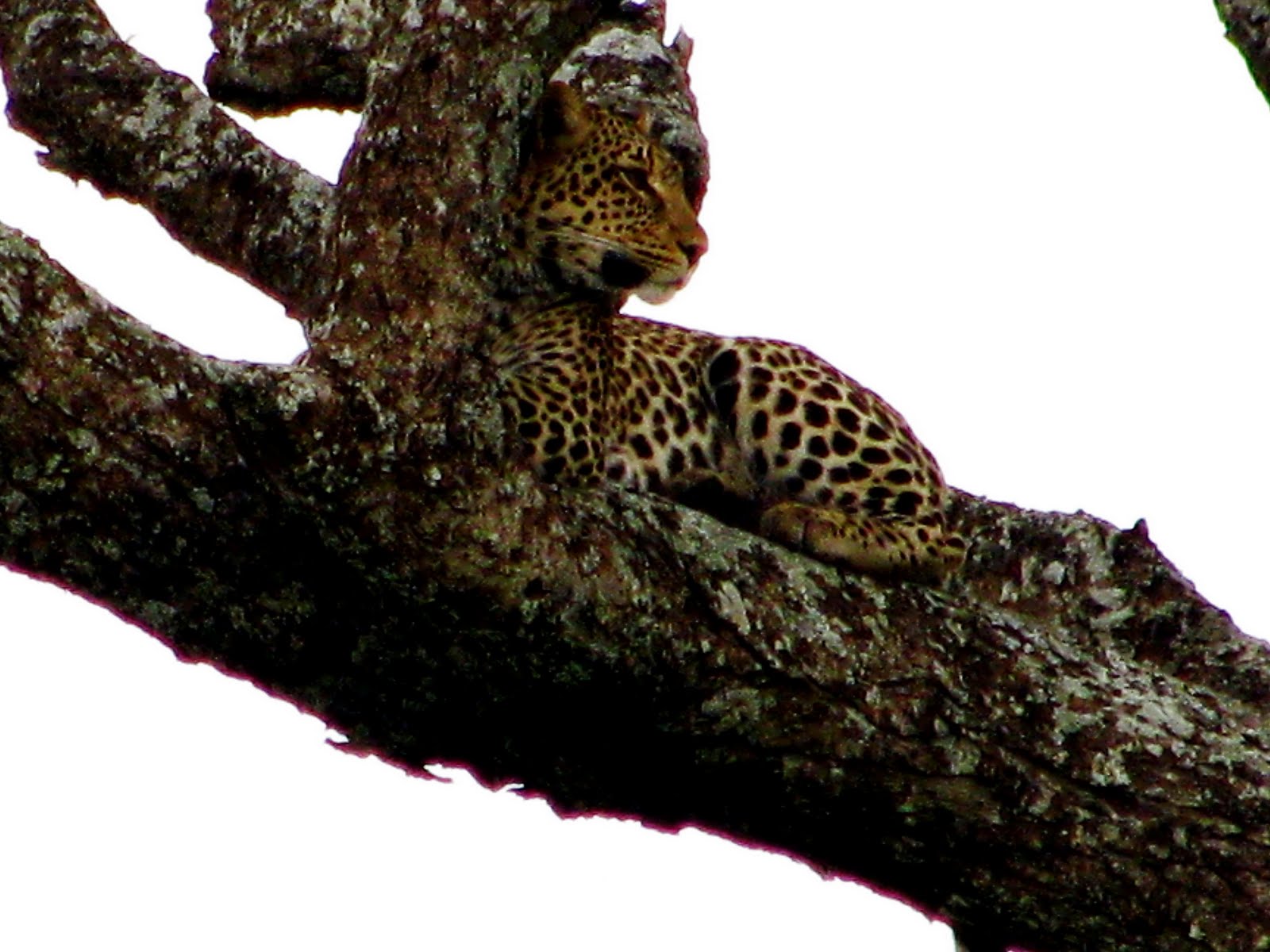
It's a miracle we saw anything at all as we drove across the plains, our driver continuing with his questionable driving sense by going 95 km an hour along a dirt road. No idea how we managed to see the more common animals, let alone some lions and a leopard. For the lions we broke the game reserve rules and drove off the road to see our first pride resting on a raised grassy knoll. When we saw the leopard we'd given up all hope of seeing one on the trip and were on our way back to camp after our last game drive. We saw about 15 safari jeeps parked all over the place. In one of the trees close to the road a leopard was sleeping off the night;s exertion with his kill hanging a few branches below where he'd dragged it.


The Serengeti bush camp was one of the most memorable places on our African tour so far. There were no barriers or fences. We were just in the middle of the open plains. In the evening a giraffe wandered over to eat a bush about 10 metres from our tent. It's only when you stand under a giraffe that you realize exactly how tall they are. At night we went to sleep to the sound of a few hundred wildebeest grunting and grazing just beyond the toilet.

Monday, 5 July 2010

Hakuna Matata...

02/06/10

One of the many varied faces of Tanzania
It has been 5 days since I’ve had time to write. The best time for doing that is when we’re sitting on the bus and we haven’t done that in a while. The mountains of Malawi and Tanzania have officially killed Benji. Even the mechanics at Mercedes in Dar Es Salam haven’t been able to fix it. After we left on the Romping Rocket minibus they managed to fix ii briefly before it broke down on a main road running right through the centre of a game park. With the help of lots of friendly villagers they got themselves to Dar and into the Mercedes workshop. Apparently it’s common for vehicles to go into African workshops and come out having had all the good parts discreetly stolen and replaced with older ones. At Mercedes every time either John or Ebron went into the workshop they got patted down on the way out. We had to stop off there and collect our tents and say an early goodbye to two thirds of our crew. They have to stay with the truck while Gareth carries on with us. It is up to them to get the truck ready for its longer and more challenging return journey.

Tanzania is an incredible place. It really is the Africa I’ve always imagined. With Mt Kilimajaro and the Serngetti planes, it has dramatic and majestic mountains that skirt the edges of flat and fertile grasslands. This is Lion King country. The people here seem more proud and confident than others when faced with a bus full of mazungus (white people). Brightly dressed women in head scarves carry heavy loads on their heads, Masai tribesmen with varieties of rich red cloth draped around them sit and laugh on their mobile phones with trainers on, holding their spears at their sides. The women here are beautiful. Tall, graceful and elegent. As well as the bright wraps many of them wear long black dresses and full headdresses. These plain outfits are surprisingly flattering, with only dark kohl rimmed eyes to be seen.

Some of the amazing beach scenes on Zanzibar
 
As well as ‘Lion King Country’, Tanzania has huge variety in landscape. We have just driven through an area that was pure ‘Hawaii’. Sharp mountains covered in lush vegetation plunging to a palm tree forest floor. Then there is Zanzibar, the feather in the cap, adding floury powder white beaches and turquoise crystal wasters to Tanzania’s tourist pulling repertoire. Zanzibar has the best of many worlds. It has the beauty of the Caribbean, the style of Morocco, and the laid back attitude of Africa. The locals greet all with ‘Jambo’ and give up on sales pitch hastles with relative ease, leaving you with ‘hakuna matata’. It is a stunning stunning place and I can’t wait to go back for a week of chill at the end of the tour.


The only bad thing about Zanzibar was the return ferry trip to the mainland. Got so seasick that my arms cramped up, my jaw started to lock and my hands went green. Glad to be away from the boat and back on a bus, even if it’s 5.30 pm and we’ve still got 300km to go.

Sunday, 4 July 2010

Death of Benji...

28/05/10

The next day... We have travelled 35 km in 5 hours. We have stopped and started again 5 times. It is 3.30 and we have 350 km to go today. An integral part of the engine has just been sent off in a public minibus full of strangers to be fixed and returned on a later bus. Our guide and chef hiked off up the road hours ago to hitch into the next town and find us alternative transport. Not only do we need to get 350 km to our next camp, but we also need to make it the 600 km to Dar Es Salam tomorrow. We have packed our bags and are leaving John and the truck. We have spent the last nine days breaking down, sitting around at the roadside, leaving in the dark, arriving in the dark, and basically trying to keep calm in the frustration of the journey. The aim of the trip has changed. We are no longer trying to spot wildlife and experience African culture, we are simply trying to carry a broken truck across a very large continent.
….
It’s 10.30. Another long, long day. Just arrived in camp. Not the camp we were supposed to sleep at mind. It’s not the camp where we had a meal prepared and waiting for us. That camp is some 70 km back in the other direction and we passed it about 2 hours ago, where hopefully the staff have now had a nice bonus meal that they had ready prepared for us no shows. How nice it would have been to stop at 8.30, eat and get an early night. Instead we have to arrive at an unknown camp, wake the owners, and pray they have rooms or set tents. We are now ‘travelling light’ and have left our tents on the bus.
We left our Benji the truck at 4.30, having managed 30 km of our 390 km day. Gareth commandeered a big minibus to take us and all our stuff the next 900 km to Dar Es Salam. Dan quickly named our new minibus the ‘romping rocket’. It is manned by to locals who drive it at breakneck speed with African music blaring out and drowning any possible conversation. With another great African sunset behind us and the most incredibly vast full moon rising in a lilac sky to the right of us, it feels like we’re really doing it African style. To be fair though, our bus is built for 26 people, and there are only 12 of us on it. To do it African style we’d need at least 60 more people on here. Earlier Gareth and Ebron the chef stopped a minibus on it’s way into town. Much to their disbelieve they were herded onto a 12 seater bus that held 30 people for the 20km ride into the next town. As Busman told us all those weeks ago in Namibia “In Africa a vehicle is never full”.
Today has been the most testing day of the journey. Sitting at a roadside for over 6 hours, being subjected to ‘Heal the World’ and ‘Words’ blasting out on a loop for 6 hours (bad dated western music soon replaced the African music), getting lost in the dark and wasting 2 more hours, and having to say goodbye indefinitely to two of our three crew. I never considered for a moment that I would be the first to flip out on the trip, but today I came really close. Frustrations are running so high that even Dan, our most optimistic traveler became despondent. 600 km day tomorrow.

There has been no photo taking on this part of the trip.

Saturday, 3 July 2010

The rot sets in...

27/05/10

It started out as any other normal day… as normal as it gets out here. Already tired and grouchy due to the night with ants, I wasn’t amused when our “fixed” truck broke down after 30 minutes. We stopped for an hour, having lost power and rolled downhill and stopped partly in a ditch, then set off revving hard. Soon after this we reached a queue of trucks snaking up the hill. We powered past them as fast as our dying truck could manage…a right ripping speed of about 20 km an hour, and onwards towards a huge lorry that was stuck in the middle of the road and blocking our view. The road was in really bad condition and full of clay. With the heavy rains that morning the road had become a wheel spinning quagmire of a car trap. We made it level with the other truck before we ground to a halt and started to slide back into it. There must have been around a hundred locals standing around and clambering up around the sides of the mud. With remarkable speed and efficiency a group of local guys gathered and produced a rope. They attached this to the front of the truck while we all clambered off into the mud. At this point I still didn’t really believe I was going to see what I was going to see.
Watching twenty men and all the guys off our truck pull/push the 45 ton truck uphill through the slippery mud really had to be seen to believed. I struggled to watch as Nick had decided to position himself right next to the sideways slipping, mud slinging back wheel, with only his flipflops for traction. Many people were barefoot. How someone didn’t lose their footing and end up under the truck I don’t know.
Incredibly they made it the 50m to the top where we gave the helpers the spare cash we had available (about $80) and they erupted into huge cheers. We then gave a lift to a local guy whose car was stuck, into the next town where he was going for a job interview. It was only then that we found out from him that the very same men who helped us get up the hill, had been out the night before damaging the road to make it impossible for vehicles to pass unaided. Doing this whenever it rains is how they make their living. Annoying, but enterprising. I was still grateful nonetheless. A tour group had had to camp there the week before, waiting for the ground to dry out.
Our journey continued up into the mountains. With the breakdowns, mud challenge, and slow hill climbing pace, it was decided that we wouldn’t stop for lunch and would grab snacks on route. We crossed the border into Tanzania with the truck making new noises of distress every kilometer. It was late and we had 70 km to go. We made it 10 km further before the pipe to the compressor snapped and we lost all brake pressure. John, Gordon and Dan stayed out in the rain for an hour trying to fix the pipe with duct tape, cable ties and wire. Having a steep winding decent on dark wet roads ahead of us nobody was really to keen to test this repair job. We made it 10m before it blew. The rain was torrential, there was nowhere to set up camp and we prepared sandwiches in our seats for dinner. Work continued on the bus and at 10.30 we were told it was fixed enough to get us to the next town. There was then a long discussion between all on board as to the merits of talking the hill with the fix verses the sleeping on the bus where we were. Surely it’d be easier to deal with in daylight hopefully without rain. We were eventually convinced that it was ‘reasonably’ safedue to the accumulating pressure tank (in non mechanical speak this means…not quite instant death when the pipe bursts going down a hill). The whole idea terrified me, but I actually slept the whole journey and woke when we bounced into the hotel carpark at midnight, the pipe having burst 30 metres up the road. Our expensive hotel upgrade cost us $30 and not having to put the tent up and down in the rain was worth every penny.

Friday, 2 July 2010

Chilling at Kande...??

27/05/10

Welcome to Africa. This has been one of the most insane and testing 24 hours I’ve had. Sitting on the bus in a hotel car park feeling very jaded, and very ready to leave the truck. Yesterday we left Malawi after a 3 night stay on the shore of Lake Nyassa, although it was a small miracle that we made it there. 100 km from Kande Beach the truck temperature gauge failed, upon investigation John found that the compressor for the breaks had sheared off its mounting and was swinging around inside the engine breaking stuff. It took him about an hour to fix this. We eventually set off with a piece of wood wedging the compressor in place. It was a bit of a wild ride into camp as the revs had to stay above a certain level to reduce the vibration and avoid shattering the wood and sending splinters through the engine. We rough roaded it at high speed down the 2km bouncy track before we screeched to a halt and the engine stuttered and died. It was an impressive enough entrance to bring out the other truck drivers and camp owner to see what all the noise was about. John and a whole collection of other people with good intentions and some novel solutions spent about 40 of the next 48 hours under the truck.

Kande Beach is a mecca for overland trucks, and while it is beautiful and spacious, it has parties every night with whooping fancy dressed teenagers running around the camp at all hours. Been there, done it, would rather they stayed in the bar and let me sleep. Yes, I’m officially decrepit. We got a few uninterrupted hours each night. The last night we finally managed ro get one of the cute beach fromt huts. That night the party was ‘magnifique’ ….crescendos of noise to beat all noise. Combine that with a hut that had a midnight ant infestation so bad I ended up with ants in my ears and up my nose, and I went off in desperation to try and sort out putting our tent up on my own. Much to my extreme frustration the lockers were all bolted and I had to go back to bed after a small private tantrum and suffer being crawled over. I got about one hour sleep that night. It was the only time in the entire trip that I was grateful for a 5.30 breakfast.

Other than the noise and the smaller wildlife, Kande Beach was fantastic. We went on a 2 hour horse riding village tour that took us at a leisurely pace past waving kids and choirs singing and clapping in churches for midweek practice. We got to wade through a 4ft deep reed filled flood plane and then finished off with a bareback swim in the lake before sunset. It’s a lot of fun but very painful if you’re unlucky enough to be sitting on an extremely narrow ex-racehorse. The next day we went for a dive in the lake. Lake Nyassa is huge and with the incoming wind it has waves big enough for body boarding. Getting the small 15 horse power RIB out through the waves was fun. The dive was nothing special, apart from being our first dive at altitude. We went round a small island made of boulders. There are sunken canoes, trees, and even an old VW jeep. For the excitement level of the dive it would probably have been best to stay on dry land as Nick managed to snap his mask as he entered the water, and then my underwater housing flooded and my camera died… not bothered about the camera, have more concerns for the memory card and the irreplaceable pictures.


A few days after leaving we heard that very sadly one of the Dutch convoy of football supporters who had driven all the way down from Holland, drowned in strong current in the lake at Kande Beach. How incredibly sad to have something so bad happen on a trip filled with hope and joy.

Sunday, 20 June 2010

WheretheMalawiarewe...?

-->
23/5/10

After yet another long day driving we arrived in the capital city of Malawi late last night. As with every time we end up driving round in the dark things went wrong. A truck of that size is not easy to manoeuvre, and getting lost and the resulting 3 point turns are no fun. We arrived too tired to deal with our own tents and gratefully accepted the offer of an upgrade to ready made cozy bedded tents for the pricely sum of $1.

Up again at 5.30 today. These early dark mornings are loosing their novelty. 30 minutes into the journey and we're climbing up slight hills at 15km an hour, before pulling over and trying to solve the never ending power problem. We waste thirty minutes at the side of the road and set off no faster. The truck is definitely on it's last legs. People are starting to get irritated. We leave an hour before any other truck and arrive hours after them. Activities and exploration time is cut short due to never ending drives. We are experiencing Africa only through a truck window. Getting up at 5.30 so we can make 400 km in a day is silly. There is now talk of hiring minibuses. It is really hard for Gareth and John, our guide and driver, it's their first trip with this company and they are having to deal with a dying bus.

Malawi, country number 5 on our tour. It has been called Africa for beginners, with it's wide range of activities, beautiful scenery and apparently the most helpful and friendly people on the whole continent. Not sure the first Western explorers to arrive here would have agreed, missionaries who came here to do their stuff. Hundreds died for every Malawian that they managed to convert to Christianity. Malaria is pretty rife here.


Malawi is a relatively small country, 900km long and between 70 and 150 km wide. A lot of this area is taken up by Lake Nyassa which separates the country from Mozambique. With a population of about 14 million in such a small area, it has one of the highest population densities in Africa. The towns we have been through have had vibrantly hectic streets; people milling everywhere, markets bustling and music and singing. As with Zambia, kids appear every time we stop to watch us, and can be seen sitting in the dirt barefooted and in rags. They shout 'Mazungu', meaning white person when we pass. You can't help but be affected by this sight when you see it so often. It hurts me that they have so little and we have nothing to really give them that would make a difference. In the past we have been told not to give kids pencils are pens as gang leaders often make kids go out and practice begging then take whatever they get. We've been told that doesn't happen here and that they are just grateful for anything that they can take to school. With an average GDP of $170 school equipment doesn't come high up on the list of priorities.


Contrary to all appearances, John says that as far as African countries go, Malawi is now doing ok. In 2005 there were drouts and famines that crippled the country but it has recovered for now. Life expectancy is about 40.
One interesting fact I've learnt about Malawi...the first president here, President Banda who had control of Malawi from 1966-1994, had some rather curious habits. As with many African presidents he leaned towards the dictatorship style of leadership, but his eccentric behaviour went as far as wearing ganster clothes and hats, waving a flywhip around and having dancing girls follow him around whenever in public, all dressed in clothes made from cloth with his face printed on it. They were there to chant praises at him.

Sunday, 6 June 2010

The longest day...

22/5/10
Just got back from South Luangwa. Got back isn't really the right term really, as we never left the bus and we're on our way to somewhere completely different, but we are back to some kind of civilization, and more importantly back to tarmac.
Our journey to South Luangwa started slowly. As I have mentioned before, the roads in Zambia are crap, even those lucky enough to be covered with tarmac. We started at 7.00 and had only done 150 km by lunch and then broke down soon after. Repairs took a long time and we still had 130 km off 'really bad' dirt roads to go. At first bouncing and bumping along the red dirt roads that were under construction was almost amusing, everything got rattled off shelves and across the floor. You drive past small thatch huts that kids run out waving and shouting from, makes you feel famous. The people here have really dark skin and when they smile it literally lights up their face. The kids we pass are all happy with nothing more than a wave and you are rewarded with this huge great grin. This along with yet another amazing African sunset and we were almost distracted from the bumping for a while. With the onset of darkness however, there came a lack of waves and smiles and the journey began to get irritating. Three hours later and even the most mild mannered on the bus were becoming highly strung. Huge potholes that whip lashed us from side to side and constant rattling that shake the bones and gets inside your head.. no stopping, no breaks, 6 hours in all on that dirt road. It was like Chinese Torture. To make matters worse we were driving in the dark, and in remote places things always go wrong when it's dark. When we eventually reached the entrance lane to where we were staying, confusing signs and us not really being able to see much after having our brains shook loose for a day resulted in us going the wrong way. After wasting another hour battling through gulleys and a track built for narrow 4 wheel drive vehicles, 3 wrong turns, 2 fallen tree blocked routes, an incident requiring sand tracks, and we were lost in the middle of a forest in a game park. Our guide Gareth was not amused when we insisted enough was enough and we really now needed a toilet stop. It took us 7 hours to go 130 km. 


The reason we went through this huge ordeal was to visit a game park with a big reputation. Not only is it reportedly one of the best places in the world to spot the elusive leopard, but is also one of the least visited parks you can find. Wonder why that would be then...

One game drive can be much like any other, and I'm not going to bore with too many more details. That is apart from to say that South Luangwa is the Jurassic Park of game parks. It is not the flat open planes from the TV, but it is huge and it is beautiful. With a river, small planes, forests, ponds, lagoons and coursed with winding waterways, it's the perfect image of a game park. We didn't see anything new there, no leopards or lions, but the concentration of animals was incredible. It was the game viewing I've always imagined, giraffes blocking the road, piles of hippos snoozing in green stuff, baby elephants next to the car. We even had hippos nudging tents at the stunning riverside Wildlife Camp. The only bad thing about being there was the fact that we were 6 hours away from the nearest tarmac and had to go back the way we came. 


As you travel through Zambia you are constantly reminded of how poor the country is. Dan was followed a kilometre back to camp by a kid who had asked for a pen and was willing to do a 2 km round trip just for a pen. At our most recent grocery stop lots of left over stale bread was given to the guys hanging around our bus. It's quite humbling to see men get so excited over slightly mouldy bread. You quickly realize how privileged we are. Apples with a few bruises that get looked at and then put back by everyone on our bus are seen as a real treat by kids with no shoes. Life expectency here is 33. 


Zambia... the beginning of the decline of Benji.

-->
20/5/10

Zambia…seem to have developed narcolepsy since we have left Livingston. Struggle to stay awake for more than twenty minutes at a time on the bus. Not sure how it is possible to sleep so much, in the words of the Lonely Planet ‘Zambia’s roads are crap’. We have just suffered a breakdown. Our truck 'Benji' is starting to crack under the pressure. With the amount of shaking and rattling we’ve done today it could be any number of things that have shaken loose.

With all the sleeping it’s been hard to see the country. Bit annoying really as it is quite a different landscape to what we have been trough so far. The rolling hills are thick with trees and the roads winding up through them remind me more of Central America or Indonesia. From the few lucid moments I’ve managed, the other difference that’s quickly apparent is the increased population. Zambia has about 11 million people, a great deal more than the last two empty countries we’ve been through. There are small thatched rondhavel compounds everywhere. Kids, cows and coats wander along the side of the road. It’s hard to find a private bush stop toilet, within minutes some curious sole has popped out through the bushes, wandered over to take a look or ground to a halt on a bicycle by the side of the road. Over 50% of Zambians are subsistence farmers, people spread out all over the place living off the land and leading a very basic life. Zambia has had its share of problems, and in recent years has been one of the poorest countries in the world. People earn about $60 a month. Driving through the small towns you can see religion and experiences reflected in shop names. The “Good Struggle Grocery”, “Faith is my food” restaurant, “Jesus is my way” grocery, and my personal favourite; “The Hangover Clinic”.

We have been driving for 3 days to get to South Luangwa Game Park. We have been told that the drive is well worth it when you get there. Whoever said that hasn’t been along this road recently. Due to its remote location it is one of the least visited game parks in the world. It has been a long drive. 1200 km in all. In the trip itinerary we were supposed to make the journey in two days, but as we had not others joining for the next leg we left a day early. Broke the marathon journey up and had the bonus of a campsite with zebra wandering through it.

Friday, 4 June 2010

Zambia

-->
18/5/10

Zambia… been in Zambia for 5 days. One trip has ended and the other has begun. Seven people have left us and now we are nine. Usually more would have joined us, but luckily they didn’t. strangers would probably struggled to fit into the group. We know each other’s quirks and habits, irritations can mostly be avoided as we are comfortable enough with each other to get things off our chests. We also now have more space to spread out. Nick and I are still sitting together, as are our favoured neighbours Gordon and Carol. We thought about moving as our position in the bus means that we are baking in the sun for most of the day as we head east, but sitting next to the humerous an mellow Canadian couple helps us keep calm and laugh off frustrations. Besides, Dan decided he wanted to spread himself over both sides of the isle, and is now occupying the last four remaining seats. Dan is our only American. He is an ex airforce and commercial pilot. He has been trying to learn English slang to help him ‘blend’ and not stick out as the American guy.


The cross over time between the two trips was spent in Livingston, south Zambia. We had 5 days to relax, get organized, do washing and get our fill of adrenaline rushes with a whole heap of activities on offer. We decided to skip the activities. Mainly because they were really expensive, we can do it cheaper elsewhere, but also because the only unique thing I wanted to do was fly over the falls, and this is no longer possible. It is possible to go in a helicopter, but at $150 for 15 minutes without guaranteed window seat it seemed a bit pricey. A microlight flight was cheaper, but you’re not allowed to take a camera. If I’m going to put myself through that much terror then I at least want the shots of the view. As for all the other activities, a disproportionate amount of them involved doing stupid stuff while swinging around on the end of a rope, and that’s never really been my thing.
We did of course pay a visit to the mighty Victoria Falls. The horseshoe shaped trench that makes up Vic Falls and stretches between Zambia and Zimbabwe has to be one of the top 3 most iconic waterfalls in the world. You can hear it thundering from about 5km away, and can see the cloud of spray above from even further. It is awesomely powerful and is locally known as ‘The smoke that thunders’. It is also known for being misty, but at this time of year the Zambeezi River is at its highest and 500 million litres of water flow over it a minute. Frustratingly for us the spray is so great that little of the waterfall can be seen. You know you are standing in front of one of the most impressive sights on earth, and you’ll likely never be there again, and it’s like someone has draped a big white cloth over it.


What we did see of the falls was incredible. We took the underwater housing and walked deep into the spray along the ‘Knife’s Edge’ trail. The spray was so heavy it was like walking in monsoon rains at their worst. We got drenched, our shoes and socks full of mud and sand. Sadly, and illustrating the poverty of the country, a craft seller later tried to swap a 10 inch wooden carving for those same dirty wet socks. The market traders are desperate and pushy, all chanting ‘it’s free to look, touch, touch, it’s free to touch’.

 
Livingston itself is the first place we’ve been in Africa where I’ve felt intimidated and uncomfortable. There are so many people trying to get you to buy things, exchange cash or give you something. I am ashamed to say I avoided it totally. We were staying at a beautiful riverside camp called Zambeezi Waterfront. It looked posh but it was mainly used by overland trucks. We had the misfortune of our one night of dining at the bar being the night of the England Australia 20-20 World Cup final. There was a group of teenage/early twenties Brits and Ausies who were waving flags, had painted flags on their cheeks, sand yobbish sporting songs and then vomited all over the toilets. Nice. Another annoyance in the camp was the herds of blue balled monkeys that caused chaos. One sat in the tree over our food prep table, looked at me, looked at the food, looked at me again then poohed just as I worked out what was happening and snatched the food away. They’ve learnt that by doing this they get the food when people throw it away.


Thursday, 3 June 2010

Botswana to Zambia....

Getting on the internet is a nightmare, my apologies that this is so slow to update.
14/5/10

Botswana...done 3 days in the Okovango Delta, then a 600 km drive up to Chobe Game Park. Botswana is how I always imagined Africa to be. There are no fences around the game parks, the animals just wander wherever they want. You drive through towns with herds of elephants grazing on the outskirts, warthogs hang out outside supermarkets and on the hotel lawn, and mongooses scutter around the campsites. Our campsite was on the banks of the Chobe River, and after spending 15 minutes standing at the water’s edge taking photos of the hippos there, we got warned that there was an aggressive mother and calf, and a croc hanging out, all 10m from our tent.


For our sunrise game drive in Chobe we split into 2 groups and went in the tub like viewing vehicles. We all had high hopes for lions, hippos and elephants. If there’s wildlife wandering on the main roads then the game park should be heaving. In the first few minutes of entering the park we saw fish eagles, maribu stalks (one of the ugly five, huge great carnivorous birds), a ‘thunder’ of hippos (probably the coolest name for a group of animals ever come up with), and lots of impalas. Then we had a rush of trucks and cars coming towards us. Lions had been spotted in another area. We followed back the way we came towards the gate. It was easy to see the area where the lions were hiding, the 15-20 cars bunched together were a slight give away. We were at the back of the group that had clustered so tightly they had blocked the road and we couldn’t see anything. Our guide started to maneuver out of the way when a lioness and her 5 cubs walked out behind our truck. We went from being in the worst spot to being in one of the best, much to the dismay of all the trucks parked in front of us. There was a lot of shouting and telling us to move, but in their haste to see before they’d wedged in so tightly that there was nowhere for us to go. We got to watch the cubs as they tentatively wobbled across the road. The other half of our tour group didn’t get to see and they were pretty disappointed with the whole drive. No cats, no elephants, no giraffes. Apparently their guide kept stopping for 15 minutes a time to show them the same kind of bird which we’ve all seen many times before.


The evening river cruise was much better for all. There are 60,000 elephants in Chobe and that morning we’d not seen any of them. From the boat, with cold beers and another great African sunset, we got to see huge herds of elephants drink, swim and play at the river edge. As well as big bulls, teenagers and mums, there were also some really small babies. Baby elephants and baby lions in one day, a successful safari day.


Have now just made the border crossing from Botswana to Zambia. The two countries meet for a stretch of about 100 metres, and then only on 2 sides of the huge and fast flowing Zambeezi River which is full of hippos and crocs. To cross the river you get on a ferry that is big enough to hold only two trucks. It takes about 20 minutes for the ferry to make it to the other side and about 20 minutes to unload and then load before returning. With 2 ferries running and crossing midriver they must only make about 24 crossings a day. There were about 100 cargo trucks parked in a queue waiting to get on the ferry. Thankfully for some reason we went straight to the front but we still had to fight to get on. Not sure how much must have been paid to jump the queue, and I did feel guilty about it, but some of the trucks had been waiting two weeks. That definitely wasn’t part of the plan.
Botswana is supposedly the least corrupt of all African countries. It was a British protectorate until 1966. In 1967 the second largest diamond strain in the world was found. The GDP went from $200 a year to fifth in the world within two years. The government then invested a lot of this wealth into the country. Not sure it went to the schools though, as we saw a group of school kids waiting for the ferry to take them on a daily journey to a better school in Zambia.