Sunday, 10 June 2012

Aprons on and burners at the ready


Most teachers will tell you that they spend all year battling the germs that lots of snotty little noses are determined to give you, hardly ever taking a day off, only to hit the holidays and fall apart. This has been an intense school year, and in preparation for the inevitable crumbling that will occur as soon as the last bell rings, I decided that unlike most years where I do something akin to a baseball players slide into last base, I would instead ease off gently and gracefully coast to the finish line. As a result of this my crumbling has occurred a week early and I have had four days of chest infection and three days of migraines. Looking for the silver lining, hopefully this means I will be germ free for the food, sun, pool and wine fun of three weeks in Europe. 

As well as falling apart this week I have been bothered by that tedious task of report writing. This is the fourth time this year that I have had to write reports and to put this laborious task into perspective I have to write six paragraphs for fifteen children. This amounts to around 9000 words. That is about the same as a thesis. By the end of next week I will have written four theses in ten months. Thankfully one of the reasons we took this job in particular is that we would have some influence over how things are done. Next year we have this down to three report cards.

Despite report writing and illness, I did actually manage to get out and do something different this weekend. Deeply hidden in the medina in Fez lies the Café Clock. This English owned café is a maze of rooms and terraces and is a sight for sore eyes (and taste buds) for those needing a break from the typical Moroccan dining experience. With movie nights, sunset concerts, Arabic courses and exhibitions, this place is more than just a café. It reminds me of the best backpacker places I have seen around the world. Not too cool or fake, it is warm and welcoming and a monster camel burger on the multi-levelled roof is a must. Unlike too many Moroccan eating establishments it is quick and efficient with amazing staff.

One of the things I have been keen to do is get a handle on the basics of Moroccan cooking. Clock Café is highly recommended when it comes to their cooking courses. Costing 60 Euros but lasting over five hours and including medina shopping trip and three course meal, this is more a cultural experience than a cooking course. I’m not going to go into the details of the course today, this needs a post of its own, but I did think I’d share the recipe for one of the dishes we made; Zaalouk. Zaalouk is a Moroccan salad made of smoked aubergine. This is not one of the prettiest dishes but it tastes amazing and smoky and is great for the summer days ahead. 

Zaalouk Salad
(Courtesy of Café Clock)

3 aubergines
2 tomatoes peeled and cut into small pieces
1 small hot pepper (optional)
1 head of garlic
1 handful of fresh parsley
1 handful of fresh coriander
1 tsp lemon juice
1 tsp ground cumin
1 tsp ground paprika
Pinch of black pepper
Pinch of salt

Wash aubergines and place in the centre of the gas hob (that’s right, no pan, just into the flame). Every minute or so turn the aubergine so that all the skin is lightly burned and the flesh feels similar to a bruised banana (appealing yes?). Remove the skin and cut into small cubes. 

Wash and cut the hot pepper if using and place in a pan with the cut aubergine and all the other ingredients except the herbs and lemon juice. Over a medium heat mash the mixture while all the spices heat through. 

Let the salad cool a little before mixing the herbs through with the lemon juice. If you’re anything like me, add more salt at this time.

Best served with a variety of Moroccan flat breads, failing that it’s good with pita and crusty bread.

Enjoy!!


Sunday, 3 June 2012

This weekend...

Last week our excitement of our much anticipated European holiday got the better of us and we decided we just had to go this weekend. For that reason there will be no post this week. I could tell you more about the secenery on the drive there, all burnt and dusty with no remnents of the green of last month, but that is probably getting a little old now.

Apart from that... 13 days of teaching to go... 15 days before 9 weeks of freedom. Now is the time of year where the majoriy of teachers remember just why they like teaching. After months of pushing and banging our heads against walls, rules are now followed, expectations are met and fun can be had. Sadly the battles all start again next year.

Sunday, 27 May 2012

Kasbah life


Morocco is famous for many things; tajines, kaftans, lanterns and mysterious blue robed men leading camels amongst them. One of its most, if not the most renowned image of Morocco, is of grand red stone kasbahs perched on cliff tops or dusty river banks. These enormous fortress like homes are all over the country and are remnants of a life not so long past.

Foreigners are presented with a very romantic view of kasbah life. One of billowing, colourful drapes, cosy cushioned corners, luxurious room and protective walls sheltering lush palm tree filled gardens from the external extremes. If you go on 'all knowing' Google you find pages and pages of examples of just this kind of kasbah; rose petal littered footpaths, spa rooms and swimming pools. While this is now the most common use of these grand buildings they have a much more practical past. Like English castles, only far more abundant and slightly less regal, these places were the centre and defence of all village life. 


When taking a tour of the Southern Atlas Mountains a few months ago we visited Dades Gorge. This lush valley is one of a few green oases that cut along the middle of the barren and near waste-land that runs along the south of the Atlas and north of the Sahara. Spread out along the 25 kilometre valley are over twenty enormous kasbahs. Most have fallen into disrepair. Some have been maintained and are still lived in by locals, some have been given a major face lift and are now grand hotels.


While we stayed in the gorge we were taken by a local guide to visit an old crumbling kasbah across the river. Walking around this giant ruin of a place we got a bit of an insight into real kasbah life.

Kasbah life was still the way of life for many Berbers as recently as 20-25 years ago. Our guide said 15 years ago, but knowing Moroccan sense of time I take this as an underestimate. The kasbah was used as a way of initially protecting families and livestock from wild animals and enemies. This was originally other tribes, but later in battles with the French while fighting the protectorate. The tall mud walls made from straw, local clay and goats hair had few windows and acted as a fortress. Inside the kasbah there was a 'fire room'. A large open air area which was used for making great big fires when they were under attack. This was to signal distress to other kasbahs in the area. Although very large, inside the kasbah walls many families would live along with the animals. There would be kids and goats everywhere with very little private space or peace and quiet. It was cramped and smelly. 
 
The fire room.
The old kasbah wash room.


After the French released control of Morocco in 1955 Kasbah life slowly begun to disintegrate. With no more enemies and relative calm, locals began to appreciate the space and quiet that could be had by moving away from the kasbah. Simply by gaining permission from the local tribe leader it was possible to build a private home with space for animals and agriculture. Our guide said he spent his early childhood in the kasbah and talked of the 'freedom and peace' of living in relative isolation now.

Sadly, when people leave these majestic buildings there is no need to keep repairing the roof and walls. When damp gets in the walls quickly weaken and then crumble. The roof timbers get taken for fire wood and what was the strength and centre of the community for over a hundred years becomes a ruin in less than 30 years. 


While visitors are usually given an unrealistic kasbah life experience, it is our romantic notion of this life that keeps us coming. Without this interest a far greater number of these incredible places would soon disappear into dust. A part of Moroccan history only kept alive by slightly misleading movie sets like Ait Benhadou.


Sunday, 20 May 2012

Lost in translation


When you have lived abroad for over 10 years you are bound to encounter a number of occasions when no matter how hard you try or how clear you think you have made yourself, things get lost in translation. Yesterday I had one of those experiences when I visited the hairdresser for the first time in Morocco.

I have never had a high maintenance hair style and am pretty happy with a haircut and highlights once every five or six months, but when you live in a country where your communication skills are limited to hand gestures, a visit to a hairdressers can become an intensely stressful experience.

What makes it worse is I usually find myself in a country where I am surrounded by people with coarse, dark hair; the complete opposite to mine. No big deal until you request highlights from hairdressers used to needing to use high strength bleach for an hour to get any colour difference. Knowledge of this means that sitting down in the hairdresser's chair is akin to going to the dentist. Only the results can be more traumatic and for all to see.

Surprisingly, my luck with hairdressers has been reasonably good. The number of times I’ve sat sweating and biting my nails in a hairdresser's chair in Thailand panicking that my description of how thick I want my highlights using language normally used to choose noodles for soup has not been understood. You spend an uncomfortable hour running through a constant stream of questions of such as 'is it going to be light enough? Is it going to be too light? Is turning orange? Is it going to fall out?' This is the continuous cycle in your brain until the hair-dryer starts to do it's work and all questions are answered one way or another. Thankfully in Thailand I was usually okay. There was the occasional garish orange tint and one slightly green week, but nothing I couldn't deal with.

Yesterday's experience was my most stressful yet. Having asked for highlights and demonstrated the thickness, required use of foils and area to be highlighted with hand gestures and Nick's basic knowledge of hairdresser French, I was left alone while Nick went to do the shopping, wonderful husband that he is.

It started well, the girl doing the foils seemed to know what she was doing and my stress eased. She had obviously understood exactly what I wanted with unprecedented speed. It was only after the front sides of my hair had been done and she started on the very back that I realised that I was getting a whole head of highlights. This I accepted without comment, I’m not fussy, and it's cheap. However, when after 40 minutes of the front of my head sitting in bleach and the top of my head was still not in foils I began to panic. Half of my head was well and truly cooked, while to other half hadn't even been started. I sat and panicked about this for about ten minutes, just how were they going to solve this problem? Surely at best I was going to end up with an orange crown and hair loss at the front. I am ashamed to say that while I can understand quite a lot of French, when speaking I am is still limited to being able to ask for a glass of water and that's about it. I was stuck with my stress in silence.

At the point when another hairdresser came over to check one of the front foils and she asked him something in Moroccan and he responded 'safi' meaning 'done', I watched her start to share my panic. She had obviously underestimated the speed with which my hair stripped itself. You know it's bad when two hair dressers start frantically inspecting your hair and whispering words behind your head. I didn't understand a word of the Arabic spoken, I just felt their panic accelerate mine. It was then that I began to text Nick and warn him to expect the worst. My luck had run out and I was going to lose hair. There would be tears. Why oh why do I always choose to live in a country where the majority of the people can't understand a word I’m saying?

Having prepared Nick for disaster, I think he was quite surprised when sometime later I arrived at the car with probably the best hair cut and colour I’ve had in a long time. This was partly to do with the miracle of a wet towel used to strip the bleach off the overcooked hair while the other hair got to catch up, and partly because the male hairdresser who arrived to cut my newly washed and unconditioned hair (they don't use it here) had little patience for de tangling and simply combed as far as his frustration would allow before cutting off the rest.

This experience reminded why I only visit a hairdresser's once every six months. Time to start flying home for haircuts perhaps?

Sunday, 13 May 2012

Michelin living in Meknes

Over the last two weeks we have been off exploring some more as we have had Nick’s mum and step dad, Val and Bill to stray. During that time we discovered a new hidden gem of a place to visit as well as returning to a riad that has secured its place as a firm favourite. As you may have read in the last post, there are always frustrations involved in travel here, this means it can be a real find when you discover somewhere you know you can count on.

The first place we visited was a farm stay about thirty minutes north of Meknes just by Volubolis. This 100 year old farm is the closest building to the Roman ruins of Volubolis. A law was drawn up in the 1930’s stating that no other buildings could be built in the vicinity to protect the archaeological site. Over the last 10 years ex Michelin chef Azzedine has rebuilt this abandoned farm that had been left to go to ruin. Returning from working in Utrecht in The Netherlands in a top restaurant, he then drove to the bottom of Africa and back in an old Landrover. Proficient in French, Arabic and Dutch, it was on this massive journey that he learnt basic Spanish and English. Azzedine then returned to Morocco with a dream of opening a gourmet farmstay. This he is doing step by step and he calls his guest ‘participants’ as each stay contributes to further renovations. He currently rents out 3 rooms in the house and one in a side annex while he lives in an adjoining house. His current project is to turn an enormous old barn into a restaurant and two further bedrooms. The stay is usually half board and for $40 a person you are treated to a five course evening meal either inside in front of the fire or outside under the stars. 


G+T time in the first sun of the hol.


The farm stay was distinctly rustic. The rooms were chilly and slightly musty, the lounge dark and lit only by an overhead light, and of course there was the usual lack of bedside lights. But strangely, you could forgive it here due to its uniqueness. There are not many places where you eat your breakfast on a terrace surrounded by roosters, geese and guinea fowl and get a fine dining experience on a farm.  At the bottom of the garden there is a babbling stream which, if you are lucky, and we were, you’ll find wild terrapins. Going at this time of year you are also treated to a garden overflowing with wild flowers and swaying fields of golden wheat stretching off towards the horizon and ruins. It is like a scene out of Gladiator.
http://www.walila.com/inside/


At the end of Bill and Val’s stay we took them back to Meknes to Riad Maison da Cote. This was the first riad we went to when we arrived in Morocco and having been to quite a few of them since, I can’t recommend this place enough. Unlike most riads it is just single storey so the interior courtyard is bright and sunny and full of overladen orange trees. The rooms are unusually bright and airy and it is a quiet haven from the sounds of the medina. There are two suites and one double available to rent and the whole riad can be rented for around 160 Euros a night. It is a beautiful and colourful riad that is half the price of most that are available in Fes. Even though Riad Maison Da Cote is in the smaller and less known of all the imperial cities it is a must visit.
http://www.riadmaisondacote.com/


Saturday, 5 May 2012

This weekend...

As we have visitors and are off exploring I don't have my needed 3 hours to sit down and write a post... yes, sadly these things always take longer than expected. For those who have kindly taken the time to check up on what has been happening I thought I'd brighten your day with some flowers... 

These pictures were taken while exploring Volubolis half an hour north of Meknes. We had to climb through a hole in a fence into a farmer's bean field to take them but this natural wonder was worth it. 

I also wanted to add a further humorous tale that I forgot to put in last week's post 'Western Expectations'. Talking to Australian friends who are living for ten months in the newly constructed Best Western hotel that can be seen out of our window, they mentioned that the hotel complex had been visited recently by the Minister for Tourism. They wondered what was going on when lots of people in suits appeared and started rushing around to prepare the place for the visit. Loose ends were hidden and the pool was topped up and debris cleared out in an aim to impress their important visitor. 

Although now debris free and full, the pool was still covered in slime, but out of time to do anything about it, someone had the good idea to use this slime to write the name 'Best Western' across the bottom of the pool. This is just another fine example of the Moroccan take of thinking on your feet. 

With that thought, enjoy some real Moroccan beauty. 


Sunday, 29 April 2012

Western expectations...

I consider myself to be reasonably well travelled. Having spent nearly a third of my life abroad, both holidaying and living, I believe that I should be experienced enough in the ways of other cultures to be both flexible and accepting. During our recent explorations I have come to the conclusion that in reality, I am sadly somewhat lacking in both of these foundational traveller skills.

To be fair this is not a wholly new discovery. In Thailand I would regularly air my frustration at the fact that many people have a deeply set inability to walk in straight line without dragging their feet along the floor, or that it always took three people to do one person's job, or the absolute impossibility of all parties in a group having their food on the table at the same time. But as has happened once before when I left Thailand swearing I would only return in transit, in the face of other cultures habits, I have found myself longing for the relatively forward thinking nation that I called home for six years. This may be a case of simple 'absence makes the heart grow fonder' or it may be that generally in Thailand you knew what you were getting. If you go out for fast food, it's fast, if you order breakfast, yes one will be late, but at least you get to start on the first one, and if you pay for a relaxing weekend away in a nice hotel, you get a relaxing weekend away in a nice hotel. And yes, I am carefully omitting to mention all the stress you usually had to encounter getting there, but that's the nature of writing...

Living in Morocco we have found that nothing is ever simple; a car journey that should take 4 hours will take six, even if you are on track for the first 3.5 hours of it and you think that this will be for a change a journey that goes to plan, you are doomed to encounter some hitch that scuppers you and leaves you steaming with unhealthy frustration; when out shopping or eating you remind yourself of all the tricks of the trade and keep your wits sharp so as to not get conned, only to get blind-sided by a totally new tactic for ripping you off; when searching for a cosy weekend retreat you instead find yourself shivering under the covers in a beautiful but unheated room cursing the failing hot water system. To us, these are not luxurious things that we long for. They are simply the things that we have come to expect and take for granted with our western upbringings. Is is too much to ask to make a journey on time, get what we paid for or have hot water in a room. We have turned into critiques of the worst kind. The simple pleasure of having a bedside light can fill us with joy the minute we walk in a room. We are finding that we are spoiling one of our favourite pastimes that we cultivated so well in Thailand... the desire to explore.

An example of this frustration occurred when we were travelling back from the south of the Atlas Mountains. Preparing ourselves for a undoubtedly longer journey than expected we left with plenty of time and unlike the day before allowed ourselves time to search out somewhere that would serve us food for lunch (not as easy a feat as expected). While exploring Todra Gorge we spied a pretty place with a view of a palm plantation. Due to yet another bad experience of being really ripped off recently when we sat down to order we made sure we asked to see the menu to avoid getting stung by ridiculous prices. To our dismay we say that they were in fact well overpriced and we decided we'd had enough of being ripped off and started to leave. At this point our hosts brought us out tea that we had not ordered as it was stinking hot sitting in the sun. This was very kind as it was free, but it now meant that we were running late and still had to find lunch.

Making our excuses and leaving we then set off in search of lunch. We didn't want anything fancy, just a Berber omelette and salad so we stopped at a rather sad and very empty looking roadside café as we thought it should be cheap and quick. After confirming and reconfirming price and menu just to cover our bases, our host was thrilled to have us and insisted on taking us in to the enormous old house they were converting into a guest house. He was incredibly friendly and tried to speak in English when we ordered. After this we waited. And waited. And waited. Our host had disappeared until we caught glimpses of him running after kids in the street. When I sought him out he said something along the lines of 'quality fresh food takes time' and that it was coming 'very soon'. When the omelette eventually arrived we were so frustrated we had just about lost our appetites. The omelette was enormous, big enough to feed about 8 people. This immediately set all the alarm bells ringing that they had found just another way to over charge us. We ate very little of it and went downstairs to pay. We were irritated and tried not to be too abrupt, saying that we had left most of it as it was enormous and we did not have time to stay and eat it as it took so long. He just smiled and asked “but was it good'? We confirmed that indeed it was, but that was not the point. We were requested to pay what was agreed and then left.

It was only when driving away that I calmed and reflected with some clarity. This poor man who was trying to improve his struggling business when faced with the arrival of what must be quite scarce foreign visitors, had probably only wanted to impress us. He wanted to give us as grand a meal as he could where as we just wanted as quick a meal as we could. He had gone out of his was to wow us and we were ungrateful. This was a true case of western expectations getting in the way of Moroccan hospitality. I will hold a sense of guilt over this incident for quite some time to come.

With this in mind I will set off today for two days in a farm. I will try my hardest to be flexible, accepting and not simply a hotel critique.

Sunday, 22 April 2012

The Bloom


As many of my previous posts have mentioned, our explorations here have led us to see Morocco as a country made up of vast expanses of barren dusty land interspersed with the occasional lush oasis nestled within a hidden valley. On our recent trip north to Melilla we drove through a land so changed since our last visit six weeks ago it was like driving through a different country. With rain comes spring and the ‘bloom’ has arrived.

The road north is a very picturesque route, even when it is dry and barren. Mountains, plains and a lake or two interspersed with the occasional small town. A lack of people keeps the rubbish to the minimum. This is one of the worst countries I have known for bushes blooming plastic bags or the national flower as they are becoming known.

This is one of the dump sites that are all over the place. At least here it's reasonably in one place and not all over the landscape.

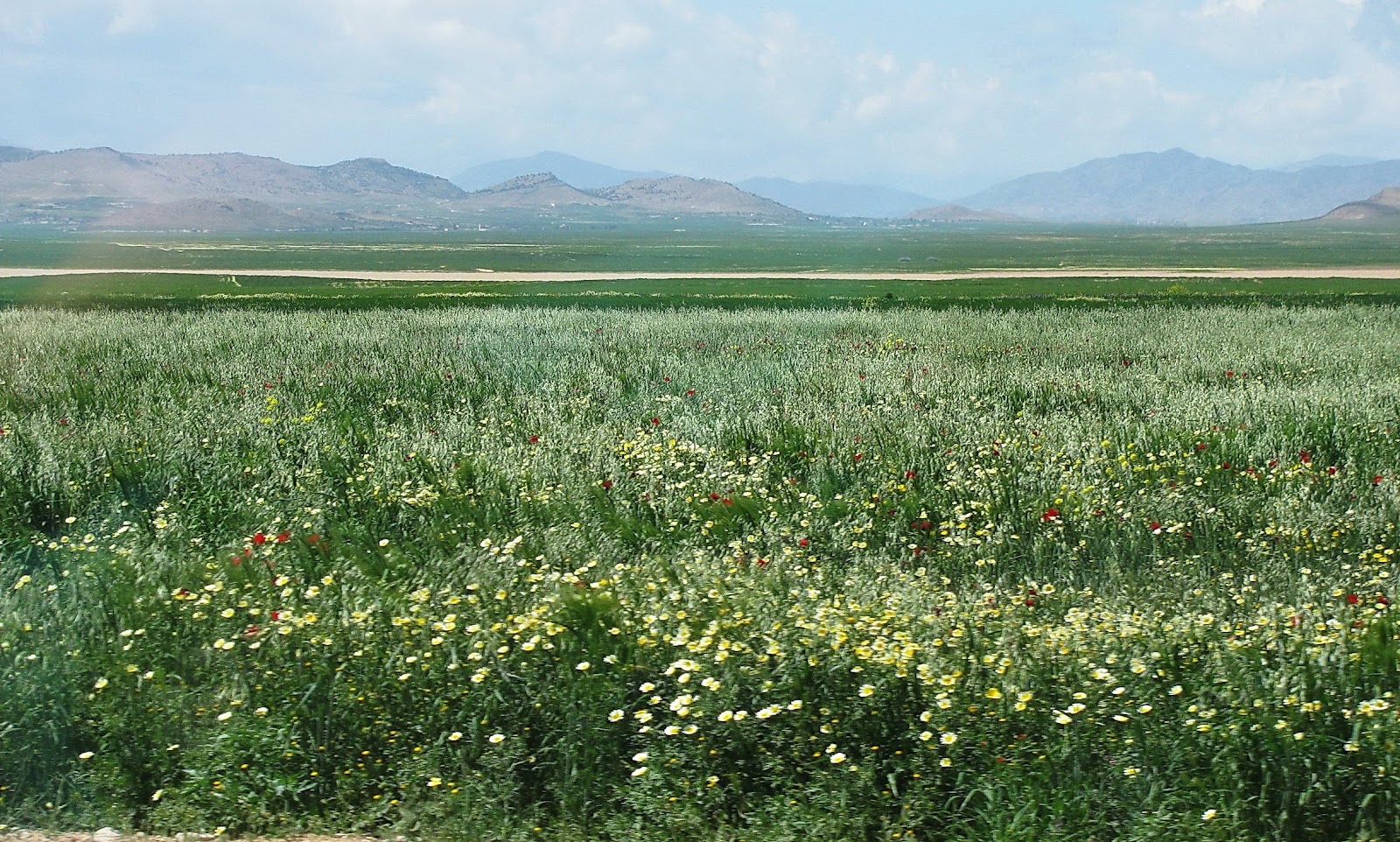
Driving through after the rains have passed and dusty rocky slopes have been replaced with a variety of iridescent greens of fresh grass. It has become a Telly Tubby land of rolling green that doesn’t look real. It left me with an irrational desire to jump out the car and skip and roll in it like a 5 year old. Fat happy donkeys wonder contentedly in shoulder deep grass. Wild flowers run riot and as the sun dips the landscape shimmers with gold.


The strength of my reaction to this green surprised me. Having spent a disproportionate amount of my childhood sitting in fields I should be more than used to a little grass around me. We have more than enough rain in Manchester for the fields to be green year round. Living here has given me a new found appreciation for grass. I don’t take it for granted any more. Witnessing hundreds of kilometres of apparently unfertile brown land transform into waves of green billowing in the wind has to be one of the most spectacularly refreshing seasonal changes I have ever encountered.


Melila
I was quite convinced that having already eulogised the wonders of our local Spanish enclave that there would be little to write about on our recent visit. We had already experienced the cheap shopping, the café culture and being ridiculously taken advantage of in a tapas bar, how could we top that?
Ok, so this trip we did not get given ten free drinks in the first bar we walked into, it was only four. However this was perhaps a good thing as after a day of school followed by a 500 kilometre drive, we would never have made it out to do any shopping the next day. As it was we returned to Casa Marta where the same waiter over-enthusiastically topped up our drinks and gave us extra tapas before to our surprise plonking a plate of four steaks and tempura vegetables on the table. When we asked for water in an aim to slow down the alcohol consumption, he laughed and said “I no have that!” with a devious smile. Yet again he was not keen to let us leave without sneaking another drink into us. How often do you have to try and work out a tactical escape plan to pay and leave and avoid the free alcohol? Do we really look that deprived?

Feeling more fragile than we had planned the next day we still managed to get everything done we had intended, this included another ridiculous alcohol shop (we now have about 37 litres… must not panic buy) and a long lazy seafood lunch in the sun. That night we decided for the good of our health we should avoid Casa Marta and find another tapas bar. 

We went to Entrevinos. Reasonably full when we entered we were forced to stand at the bar. After the attentive care of our friend in Casa Marta we felt a little lost in Entrevinos, eye contact was hard to make with the waiter and the tapas situation was confusing. This was obviously not the place where we’d be getting free food and drink. Part way down our first drink the man next to me offered me a chair and bought us a round before he left. We then found a table and were given a steady stream of tapas and then free drinks at the end of the night. Why that man bought us a drink I have no idea. He didn’t talk to us and he wasn’t the manager like I first assumed. We obviously do look that deprived.

Entrevinos was a very interesting bar. For the first hour or so there was a constant stream of model like women coming in in groups. This was obviously the place to be. True this is no great achievement when as yet we have only found two tapas bars in town. And believe me we have tried. At around 10.00 when the place was packed with women, the men started to arrive. They arrived in packs. They may always chose to travel this way or it may have something to do with the fact that a Barca match had just finished. The thing was the long narrow bar was so busy by then that all the women ended up on one side and all the men on the other near the entrance. From these positions they then not so surreptitiously eyed each other up with the occasional brave individual breaking rank and heading over to the other side.  This was still going on by the time we left, hangovers having gotten the better of us.


Friday, 13 April 2012

Wondrous Water


After two weeks of near solid rain, I thought this was an appropriate post. While I have frequently highlighted the wonders of Moroccan mountain weather, what with the refreshing experience of seasonal temperatures, the endless cloudless skies and the crisp dry air, I have given little thought to the poor farmers who make up the bulk of the population who have been suffering from the worst drought in well over a decade. Having been raised in Manchester where it often seems like half an ocean is thrown out of the sky over the course of most months and then Thailand where it feels the same only larger quantities and faster while also living in a city that is sinking into a swap, there has rarely been an occasion to consider the effects of too little water. 

It was with talk of this 'perfect' Moroccan weather that I welcomed my friend from Manchester a few weeks ago. After far too long at home I felt that the blue sky and warm winter sun of Morocco would be just what was needed. For those who are familiar with luck of Mancunians and weather will not be at surprised to learn that after arriving in Morocco in darkness we awoke the next day to the first clouds in months. Not only clouds but later typical Mancunian drizzle. Bar a day or so it has not really stopped raining since. Maybe I could market this strategy to the Moroccan government as a future drought solution. Just fly in some sun deprived Mancs. We had our first snow of the year and a week of solid rain after our mums visited in November.

The drought
Unlike Manchester the weather here has been unusually dry. In Ifrane it is normal to get a metre or so of snow. This year we have had nothing more than a few heavy flurries. We put this down simply to the fact that we had lugged a snowboard all the way out here like idiots. As the bitter weather has warmed still the rain didn’t come, instead we have had the most perfect spring weather you could imagine. There are certain smells you associate with different times of the year. Spring has a unique morning freshness that bodes of a great day to come. While it has gone unnoticed to us newbies up in Ifrane, the rest of Morocco has been worried. Driving around the country you pass through endless dusty, barren landscape and hundreds of vast dry empty riverbeds that look impossible to fill. The spring flowers that people talk of are not everywhere like predicted but confined to small pockets. The standard greeting between locals is ‘Salam Alakum’ meaning ‘Peace be upon you’ this is now also followed by ‘we pray for rain’. There is no grass, the animals are dying and the crops are failing. For the majority of the nation who survive on less $200 a month from farming, this has been a huge concern.


And then the rain came
Thankfully with the arrival of my Mancunian rain bringer, the drought was broken. Rain lashed the length of the Atlas Mountains. Driving through it back from Marrakesh we got to see the water table rise as the days passed. For about three days the rain just soaked into the ground. It seemed like no matter how much rain fell even the bitumen of the road was absorbing water. There wasn’t a puddle to be seen. After three days pockets of water appeared, after five days dusty barren riverbeds started to trickle then flow. Everywhere farmers we out getting wet tending their crops and re-digging irrigation channels. After a further soaking this week and occasional sunny spells of 24 degrees C, we woke up this morning to a thick layer of snow. This is weather in the extreme. Yet as cold and  miserable as it is, the farmers will still be celebrating.

Water... what makes us so miserable in Manchester is seen as life saving in so many less fortunate places. Sadly, although much of Ifrane and the surrounding hills have turned lush green, and the livestock is now feasting like it’s Christmas, the rain has come too late for a few areas. What is already a hard life will be much harder this year. What is worse is that may well be a cycle that is set to continue.